

the Big Picture
Why you need a personal travel itinerary. You have destinations in mind for this trip, don’t you? Maybe you nailed it. Or maybe not. This trip is a big commitment of time and money, so use the How to Travel Itinerary Planner to squeeze the most out of it. Your completed itinerary will feed into the last planning task, your Travel Budget.
 re-test for bb error
The Big Three decisions: goals, experiences, destinations. People who choose destinations or experiences first are not travelers, they’re vacationers. They don’t consider the full potential of an independent travel opportunity. It’s 1-2-3: decide travel goals first, then Wow! experiences to fulfill those goals and finally the best destinations to have those experiences.
Confirm your destination timing. Before you calendar your trip, you need to know what weather, crowds, major events and holidays to expect. Adjust timing for the best fit.
The How to Travel Itinerary Planner
Different from trip planning apps. Trip planning apps for your device organize your accommodation and travel bookings. Some suggest activities too. The How to Travel Itinerary Planner helps you optimize your time before booking a single thing. When you’re done, then you can use a trip planning app to keep track as you go.
Whole Trip vs Next Stop itineraries. A Next Stop itinerary is a more granular version of your Whole Trip itinerary. As you near your next travel leg and destination, detail a Next Stop itinerary: specific activities at the destination, smaller time blocks, precise map locations for each event and how to use local transportation.
6-Steps to a Whole Trip travel itinerary. You need to map everything you want to do within your travel time window. You will see every major event and the time it might take.
Your itinerary will change! The longer your trip and the more destinations on it, the less likely your itinerary will stay on track. But even a three-week trip can change on the fly. It’s the nature of independent travel to follow your nose in pursuit of sweet opportunity. “Best-laid plans” will jump the rails and head off in a new direction, most often because something wonderful appeared out of the blue. Maybe you can get back to your pre-planned itinerary later. Or maybe not. Stay fast on your feet. Adapt!
If you do not change direction, you may end up where you are heading.
— Laozi

What you need to do
- Settle on your travel goals
- Choose “Wow! experiences” to fulfill those goals
- Select the best destination to do each experience
- Explore cool experiences (secondary activities) you can do along the way
- Strategize the best timing for each destination* to avoid inclement weather, crowded attractions, booking problems, high costs and other impediments.
- Use the How to Travel Itinerary Planner BEFORE you book any fixed dates. It’s a free download (below) and just 6 Steps:
- Enter your Depart and Return dates
- List your destinations and travel legs
- Estimate the days for each travel leg and destination
- Select a “Contingency time factor” and add Contingency days
- Mark “Blocks” of time around fixed dates
- Adjust the itinerary for best fit before departure and as you go
- Enjoy the best trip you can have with your available time and money
How to Travel Itinerary Planner
6 Steps to a better trip
The Planner is a free downloadable Google Sheet, available to How to Travel members. (Download the Planner or get your free membership.)
It’s expandable to manage the longest trip over any number of destinations.
Decisions you make on the Planner precede use of the “travel planning” apps available from Apple’s App Store or Google Play. They’re complementary: work up your itinerary on our Planner, then use one of the planning apps.
Do you need an itinerary plan?
- No — Lots of writers, bloggers and veteran long-term travelers say, “Just go.” Maybe you know where to go and what to do at the beginning. But as you travel, you can make better informed decisions on where to go next and when. It’s liberating. And it’s a valid strategy if you have plenty of uncommitted time and enough money to pay for your style of travel.
- Yes — Most travelers want to squeeze the best experience out of limited time and limited money. A flexible itinerary, imagined before departure and updated as you go, will help you pull off a superior trip.

Whole Trip itinerary vs Next Stop itinerary
 Whole Trip itinerary — Covers the time from departure from home until your return. Use it to list all the destinations you want to visit and all the Wow! experiences you want to have. Keep it general and flexible. Adjust as you go. Commit to bookings when you must.
- Next Stop itinerary — Covers individual events at your next destination. Since you can’t be sure of where, when and for how long you’ll go until you buy the ticket to get there, no need to plan far in advance. One to three days will do.
One itinerary, two time scales. Zoom out for your Whole Trip strategy. Zoom in for your Next Stop tactics.

The Travel Itinerary Planner layout
Create your Whole Trip itinerary. Enter any fixed dates and work around them to bring about the most flexible and cost efficient trip.
We’ll walk through an itinerary to Nepal and North India to show you how it works.
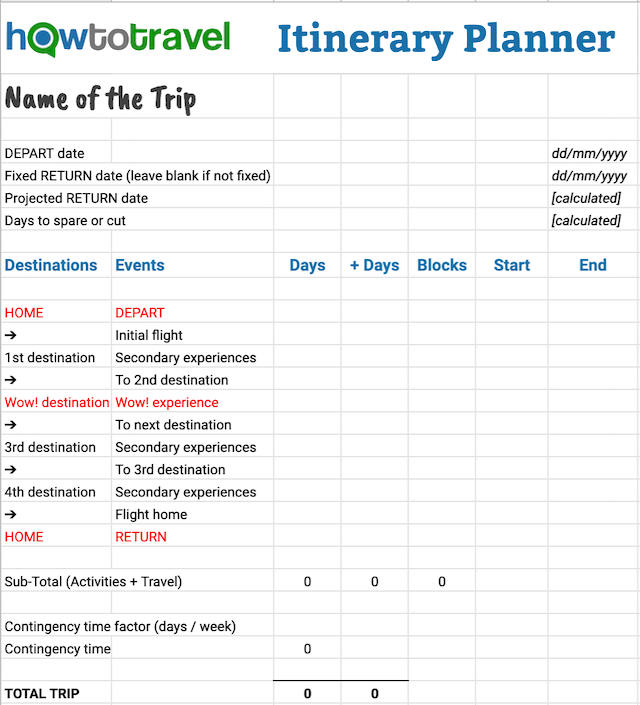
Step 1: Destinations & Events
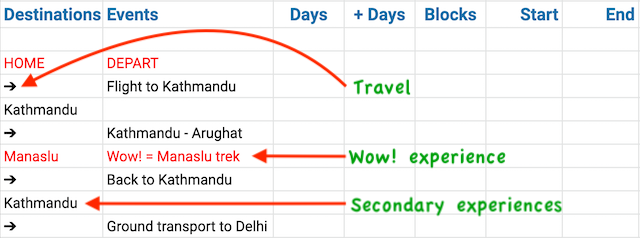
- Mark your START and END locations — Most travelers start and end their trips from “home,” their usual residential location. It’s possible you might start or end the trip somewhere else. And there’s a tiny subset of rootless travelers, searching for Shangri-La, who don’t have a return location.
- Travel in one general direction — There’s an obvious geographical logic to stringing destinations together. Cross an ocean, continent or large country just once so you don’t do time consuming and costly backtracking over long distances. Still, a big backtrack may be unavoidable for a unique Wow! experience.
- Create a row for each Wow! destination — These are the hilltop beacons, the high points of your trip. Everything else inhabits the path between these beacons.
- Add rows for Secondary destinations — Maybe you want to check out a place. Or you might have a specific cool experience in mind. Or the location could be a transport hub only. It’s simpler not to list specific activities at this point.
- Insert a row for each travel leg — These are marked “➔” in the first column.
Step 2: Estimate Days
Compare your proposed trip with time available. You have a limited window for your journey. But you need to know how long your trip will take, then see whether you can find enough days. If you’re short, learn how to liberate more travel time.
Your personal travel rhythm. Travel has a rhythm to it. It’s all you: your preferences, your pace, your style of travel. Take a plane, a train, a bus. Arrive somewhere, orient yourself, check in to your lodge and get some rest. Then you’re ready to do stuff for a day, two days, a week, a month before you move on. Your body and your mind will tell you when you get the rhythm right. The sweet spot is when you can march through your planned itinerary without hitting a physical, mental or financial wall. And don’t deny your choice to change your personal rhythm when you must. The decision to change your travel rhythm (usually slower) is another reason strict itineraries don’t work.
3 types of days
- Wow! experience days — You should know how long a Wow! experience will take and when the best dates are to do it.
- Planner example — The usual time for the Manaslu Himalayan trek is 16 days. But it’s a rigorous trek and we’re older and slower, so we’ll give ourselves 16 + 3 Contingency days =19 days. (We’ll say ‘hello’ as you pass us on the trail.)
- Secondary experience days — Your research on Cool experiences shows how much time you might need. For any location except a transport connection, give yourself at least one full day. If the place sounds interesting and you have the leisure, allot more days.
- Planner example — Delhi is an astonishing world-class city, but don’t get too detailed in your planning. Instead of scheduling every event or chore (visas etc.), roll up your estimate. Delhi = 4 days. If it’s still tight, give yourself a Contingency Day.
- Travel days — It’s easy to underestimate travel time, so default to one day. Give yourself two for some international flights. Westbound over the mid-Pacific international date line adds a phantom day. Recovering from jet lag can add two. And the infamous “bus trip from hell” can leave you exhausted when you stagger off. Even a shorter trip will take more than the scheduled A-to-B time. There’s going to the transport hub, departure processing and delays, the travel itself, getting oriented in a new place on arrival, the trip to your lodge and feeling tired when you drop your bags on the floor of your room.
- Planner example — The trip from Kathmandu to Delhi is a full day overland. And that’s if everything runs on time. The bus from Kathmandu might wait in the bus yard for an extra hour to fill all the seats, then get stuck behind crawling trucks in the mountains near Thaha and next blow a tire outside Banaganga. It could even get hijacked and detoured by villagers rushing an injured man to hospital (true story on the Darjeeling to Kathmandu bus). By the time the bus reaches the Indian border, the train from Barhni station, bound for Delhi, has already left. Damn! Maybe you should save a whole day, bust your green credentials and fly from Kathmandu to Delhi.
Assign durations in full days.
- Resist the urge for detail — At the planning stage, slicing time any finer than one day is too labor-intensive and inaccurate. Your Best-Laid-Plans, even at one day granularity, will change.
- Planner example: in Kathmandu, you could lie out a schedule for Durbar Square, Swayambhunath, Pashupatinath, Boudhanath, Patan and Bhaktapur. That’s too detailed at this point. Roll them all up into a few days of wandering the Valley, then figure it out the details when you get there.
- “But I can do more!” — Sure, you can take a 3-hour train then do an activity on the same day. But in the Planner, assign one travel day. Do an activity on the same day = Bonus! You’ve banked some time.
- Planner example: You can take the train from Delhi to Agra in the morning. It’s a quick and comfortable A/C train and you won’t feel bagged when you get to Agra. So go ahead and explore in the afternoon. Head out to Fatehpur Sikri if it’s not too hot. (Leave the Taj for the next morning at dawn.
- Arrive a full day before pre-booked activities — To manage delays in transportation, plan to arrive one day before any activity that has a hard start time, especially if it’s pre-paid. If you arrive on time, you can recover from jet lag, do unscheduled activities or prepare for the big event.
- Half days? — Where distances are short and timetables reliable (trains in Europe and Japan), you could allot half-days. Take a morning train, check-in at your lodge, then head out for an activity. Still, unless you’re squeezing all the juice out of a short trip, roll a day of travel and activity into one full travel day.
Step 3: Dates
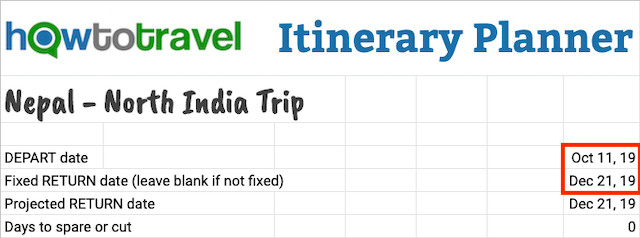
“Depart” & “Return” dates
Restricted or open-ended trip timing. Most travelers have a window of opportunity, but others have an entire “gap year” or no fixed ending. If you have a firm Return date, the Itinerary Planner will help you fit your trip into the time available.
- DEPART date — Everybody has one, whether bound by your home commitments or a target date you pick yourself.
- RETURN date — If you have one, it’s likely fixed by your need to return to work, school or important event. If you don’t have a rigid date, you don’t have to enter one in the Planner.
- Projected RETURN date — Calculated by the Planner, based on your DEPART date and the duration of your trip.
- Days to spare or cut — Spare days you can allocate to your travel and destinations OR too many days for your time available. You must adjust your itinerary (Step 6).
“Start” & “End” dates
- Dates for each travel leg and destination — The Planner calculates these dates. But you will cut-and-paste and insert rows in the spreadsheet, breaking the Start and End dates below the edit. Copy the Start and End cells from the SECOND row and paste them in the rows below.
- Best travel dates for a destination — Chilly north China during Golden Week? No, thank you! (Unless you’re Chinese and heading back home for the holiday.) Learn how to select prime travel dates* for each location to reduce the risk of bad weather, crowds and high prices.
- Restricted travel windows — Some travelers, such as educators fixed to the school year, have restricted dates for travel. Or you might have other fixed dates, such as a family event you can’t miss.
- Complete your Whole Trip Itinerary before committing to fixed dates — You may have to shift destinations and experiences, so don’t commit yourself to a fixed date booking (especially pre-paid) until you must. In most cases, you will have a range of dates to choose from, so you will craft the other parts of your trip around each fixed date event.
Step 4: Evaluate time Blocks
The biggest Block: fixed DEPART and RETURN dates for your trip. The Itinerary Planner helps you allot your time between DEPART and RETURN to make the most of your time. It’s crucial if you have an exact duration (such as three weeks) or a fixed return date, since you have to be back at work or school within a day or two.
Fixed dates during your trip create Blocks. Time before a fixed date is one Block. The fixed event itself (a Wow! experience) is a Block. And the time after it, before the next fixed date, is another Block. In the Nepal – India example we have five blocks. There are two fixed date Wow! experiences, but the other three Blocks are flexible.
- 6 day flexible Block — It includes your flight from Home to Kathmandu. But once you’re in Kathmandu, you can do what you wish. The pre-booked Wow! experience (Manaslu trek) has a fixed start date. You MUST be at the trail head near Arughat on October 17.
- 19 day fixed Block — Then you’re committed for the whole 19 days of the trek.
- 20 day flexible Block — Between the end of the Manaslu trek and the next fixed date (yoga retreat in Varanasi) you have plenty of discretion on where to go and what to do.
- 8 day fixed Block — This pre-booked Wow! experience in Varanasi is itself a block of committed time.
- 23 day flexible Block — You have no more fixed dates left on your itinerary, except your return date home. The last Wow! experience (Camel trek in the Thar desert) can be arranged whenever you arrive in Jaisalmer, so it’s not a block of its own.
How to manage Blocks
Blocks put limits on your flexibility. A short trip with multiple Wow! experiences could have short Blocks. Allot adequate time between fixed dates to manage travel time and adequate rest. Extra activities are a bonus. It’s a good idea to limit fixed date commitments, although some may be unavoidable. Transport, accommodation and experiences could get fulled booked (or expensive) if you leave them too late.
- Planner example — We have a 20-day Block between fixed date Wow! experiences (the Manaslu trek and the yoga retreat). We can do whatever we want within it, maybe save a few days on Delhi and Varanasi for a side-trip to Amritsar. (We can always catch up on Varanasi and Delhi in the block after the yoga retreat.) But we have to be in Varanasi by November 25, so it’s not possible to extend the Amritsar side-trip to Dharamshala.
Create the most flexibility between fixed dates. Beware a gap between fixed date events. If anything goes sideways, such as a brief illness, you could miss your second fixed date. Or your pace of travel* could become exhausting. Try to space your Wow! experiences as evenly as you can. (Considering best-time-to-visit* factors.) Unless the two fixed dates are immovable, add some Cool experiences or Contingency days between them.
Bank unused Contingency Days. You can bank Contingency days (working around fixed dates on your itinerary). Spend spare days near the end of your trip relaxing or exploring something new. Budget permitting, you could even add one more destination.
Step 5: Allow Contingency time
You will need all the Contingency time you can spare. Do not leave yourself short of time to absorb transportation problems, bureaucratic delays, a short illness or flop-on-the-bed exhaustion. And don’t pre-zap the opportunity for an astonishing side trip or unplanned activity.
Relaxation time = Contingency time. If your planned activity is relaxation, you don’t need Contingency time to get still more rest. In fact, you could reduce three days at the beach to two, making time for other activities.
Build in Contingency Days. Estimate a reasonable time to spend on a destination or series of activities. Then add at least one day per week for unplanned activities or rest. Two is better if you’re older, managing a condition, going budget style or traveling in difficult destinations.
The “Contingency time factor.” At the bottom of the Planner you’ll see this line where we assign days-per-week on average for un-programmed time. It’s a simple way to guess how much flexible time you should inject into your trip. If you’re a veteran traveler, you don’t need it… you have enough self-knowledge and experience to insert Contingency time manually when you assign days to travel legs and destinations. If you don’t have that expertise (yet), try the Contingency time factor and build extra time into your trip.
The Planner calculates the total Contingency days. In the example:
- Estimated trip time = 64 days
- Weeks = 64 days / 7 = 9+ weeks
- Contingency factor = 2
- Contingency days = 9 weeks X 2 = 18 days
What’s your Contingency time factor? It’s personal and relates to Pace in your style of travel.* Don’t forget to account for a travel companion’s limitations.
- 0 = Burn Fast & Furious — It’s possible, if you’re an adrenalin junkie. Many travelers on a two week blitz try it. But there’s no room for delays and no room for a Cool experience that reveals itself only after arrival. You’ll return home to get rest.
- 1 = Keep to the Speed Limit — The default minimum is 1 day per week. And only if you’re a resilient traveler in a country with decent travel infrastructure.
- 2 = Cruise in the Slow Lane — It’s often enough to absorb delays, grab Cool opportunities or just relax. Do you tire easily or manage a disability? Take 2+. Will you travel to destinations with unreliable transport, relentless physical discomfort or stress-inducing cultural and linguistic challenges? Take 2+.
- 3+ = Walk in the Park — You have time and need not rush. You want to discover Cool experiences and better appreciate local culture. Take it easy on your body. Reduce stress. Cope with terrible travel infrastructure. Hey, spare time allows you to cruise through an enjoyable, laugh-at-adversity, high-serendipity trip! (It’s how we do it ourselves.)
How to assign Contingency time
You can sprinkle Contingency days around randomly, but it’s better to be tactical. If not, assign them early in a Block. If you don’t use them early on, you can bank them. Then, when you stumble across a great side-trip, you won’t disrupt the later destinations in the Block so much.
- Short Blocks — You can loosen any Block that looks tightly wedged between two fixed dates with Contingency time, provided you can shift one or both of the fixed date events an equivalent amount.
- Wow! destinations — Add flex time to ensure completion of a Wow! experience. In the example, we added three days to the Manaslu trek to account for our slow progress over the usual 16-day time estimate.
- Hot spots — Any destination that looks interesting might be worth extra time. This includes world-class cities, where you otherwise might reduce your time due to high daily expense. They’re world class for a reason: there’s lots of great stuff to do. So, if you can afford it, you could stay on longer. If not, you can still leave after your original day estimate and bank the Contingency time.
- Long travel legs — Whether a multi-time zone flight or the “bus trip from hell,” you’ll need recovery time.
- Demanding activities or destinations — As with long travel legs, you need rest. If you’re coming off a trek or other physical challenge, give yourself time for your knees to recover. Other destinations are mentally challenging because the culture and language make your brain work hard and your stress levels can bloat. Again: find somewhere chill and blow a day or two of Contingency time.
Step 6: Adjust your itinerary
Problem: your trip doesn’t fit in the time you have available. After your first attempt to list travel legs, destinations and time for each (including Contingency time), it would be astonishing if the End date aligned with your RETURN home date. No problem if you have days to spare. But if you’re short of days, what can you do?
Problem: a time Block between fixed dates is too short. You might find that a Block is too short between fixed dates. It could mean you’re unable to take on new opportunities or cope with delays. Worst case: you miss the fixed Start date of a Wow! experience.
Solutions:
- Make more time — Delay your trip to earn more vacation days or try other travel time techniques* to cobble together what you need.
- Shorten activities — Go back to your destinations list and reduce time of stay. If your planned activity is more than a few days of relaxation (yeah, the beach), shorten it.
- Reduce Contingency days — Shave Contingency days from one or more destinations. Beware the risk of insufficient time to cope with delays or get enough rest.
- Add to a short Block with Contingency days — If you can move one of the fixed dates, slot a few Contingency days into the Block. Use them for fresh exploration or rest.
- Planner example: Our plan is good because we have only two fixed date events. Our shortest Block is the 6 days from leaving home to showing up at the Manaslu trek trailhead. It’s not too tight. Yet, you have jet lag to endure and the Kathmandu Valley is a treasure house of wonders, so you could add time to the first Block. In our example, we choose not to because later parts of the trip are more demanding.
- Re-order your trip to fit — If your timing is bad for a destination (major holiday, everything shut), re-order your itinerary, even if it requires backtracking.
- Planner example: We don’t show it, but there’s the possibility to add a side-trip to Amritsar, making up Varanasi and Delhi days later.
- Cut destinations — Cut one or more secondary destinations, including travel time. Consider whether you’ll ever get the chance to visit this destination again. You’re more likely to visit major cities and hubs, such as London and Dubai, so cut them first. Keep the most remote destinations.
- Planner example: In or original itinerary, we had 6 days too many. If we cut Udaipur off the end, we save 7 days and get back Home on time. It’s possible (but more challenging) to keep Udaipur and reduce Contingency days.
- Use faster transport on long travel legs — Fly between destinations instead of taking a long train or bus. Yes, your will shatter your green cred!
- Planner example: You could save one, even two days flying from Kathmandu to Delhi instead of going overland.
- Spend more on local logistics — If you take a lodge nearer to your activities and use private transport instead of public, you could shave hours off a day. That might be enough to stuff a cherished activity into a short stay. In big cities, these tactics save plenty of time. You’ll be less tired too.
Keep your Whole Trip Itinerary going when you’re on the road. As the days and weeks pass, you’ll be able to freshen it to keep your schedule real and flexible. (A good reason to do it on a spreadsheet.) Keep your eye on approaching travel dates, ready to pull the trigger on the best deals for transport and accommodation. This is crucial for popular, high season destinations.